World AMR Awareness Week provides an opportunity to consider the progress being made to address antimicrobial resistance (AMR). This year’s campaign theme, “One Health, One Action: Prevent AMR Now”, highlights the need for coordinated action.
AMR threatens the effectiveness of antibiotics and other antimicrobial medicines. Addressing it requires collaboration across healthcare systems, pharmaceutical manufacturers, regulators and other stakeholders.
BSI has worked with industry stakeholders to support action addressing AMR risks associated with antibiotic manufacturing and environmental discharges.
From concept to global certification
The journey began in 2020 with the development of an industry-standard approach with AMR Industry Alliance (AMRIA) to reduce the risk of AMR in the Environment linked to pharmaceutical manufacturing. Bringing together a broad group of stakeholders, BSI helped facilitate the technical alignment needed to establish a robust framework for industry action.
Following extensive collaboration and development, the Antibiotic Manufacturing Standard was published in 2022, laying the foundations for a certification programme designed to support independent assessment of responsible antibiotic manufacturing practices.
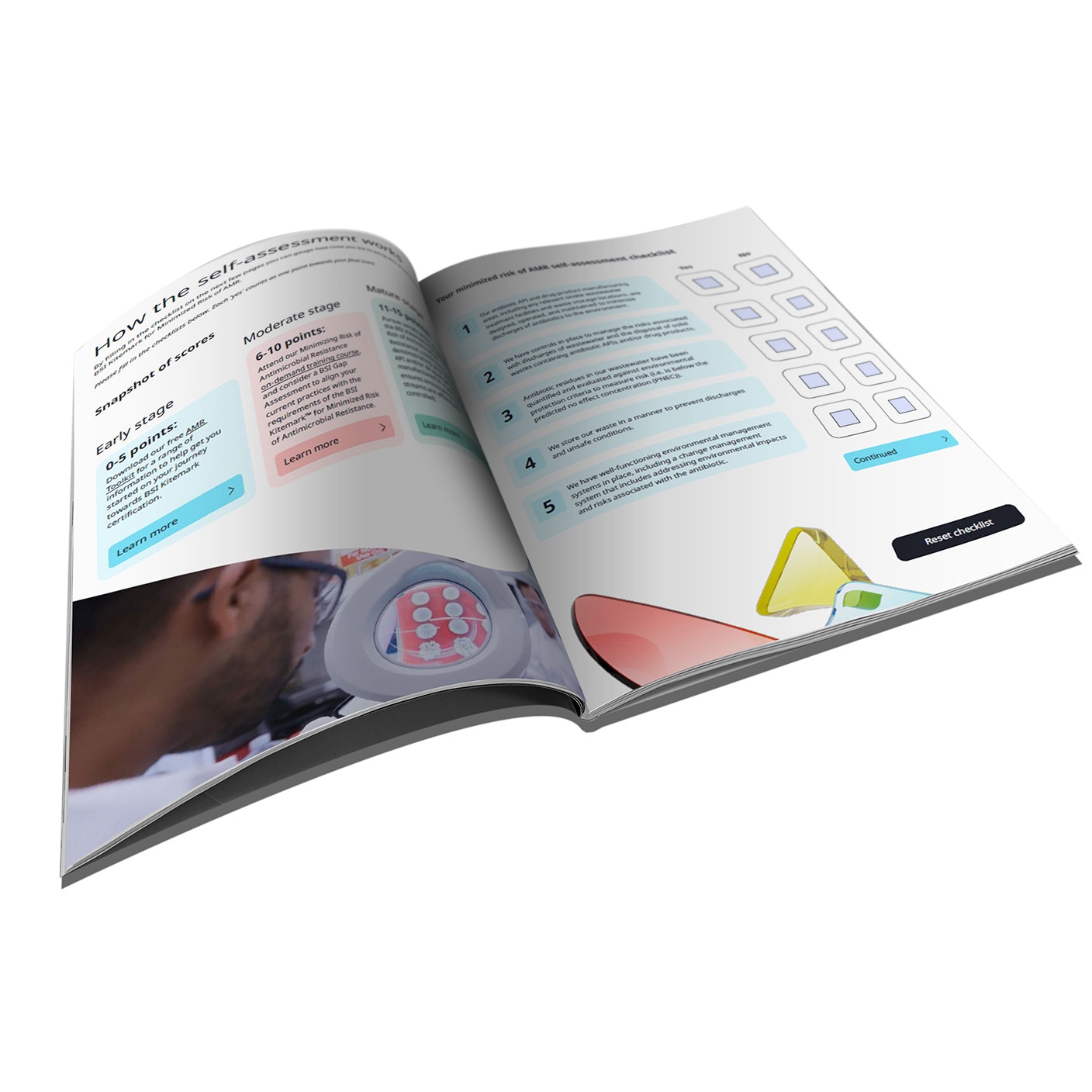
A landmark moment followed in June 2023 with the launch of the global BSI Kitemark™ for Minimized Risk of AMR certification programme, providing independent third-party assessment of specified antibiotic products and manufacturing sites against the requirements of the Antibiotic Manufacturing Standard.
Pilot assessments involving pharmaceutical companies also informed the development and refinement of the certification approach, contributing to the ongoing development, refinement, and credibility of the certification approach.
Adoption of the programme
In November 2023, specified antibiotic products and manufacturing sites associated with Sandoz and Teva became the first to achieve certification through the programme.
AMR Industry Alliance members subsequently issued a joint letter asking suppliers to align with the Antibiotic Manufacturing Standard and strongly consider independent certification.
Wider AMR awareness and collaboration
Alongside certification, BSI has continued to engage with the wider healthcare and life sciences AMR community through global events, webinars, roundtables, training and industry collaborations.
Recent activities have included participation in key industry forums, collaboration with healthcare and pharmaceutical stakeholders, support for One Health initiatives including a webinar with the Global Antibiotic Research & Development Partnership (GARDP), and engagement in major international AMR discussions, including the UN High-Level Meeting on AMR.
These collaborations recognize that AMR cannot be addressed by any single organization or sector alone. Action across healthcare systems, pharmaceutical supply chains, governments, regulators and environmental stakeholders is essential to mitigating the threat of AMR and safeguarding access to effective medicines.
No single organization or sector can address AMR alone. Coordinated action across healthcare systems, pharmaceutical supply chains, governments, regulators and environmental stakeholders remains essential.
Looking ahead
The BSI Kitemark™ certification programme for Minimized Risk of Antimicrobial Resistance transitioned to the May 2025 edition of the Antibiotic Manufacturing Standard on 1 January 2026. The revised programme requirements reflect updates to the standard and its alignment with relevant WHO guidance.
Existing certificate holders must complete their transition by 1 January 2028. BSI is providing transition information to existing certificate holders.
As of October 2026, 200 products had achieved certification through the programme.
The ongoing adoption of wastewater discharge-focused healthcare system procurement requirements and growing industry demand for supplier compliance demonstrate that awareness is increasingly being translated into action. An important example is the introduction of requirement to be certified to the Antibiotic Manufacturing standard within seven different European countries’ healthcare system procurement antibiotic tenders. For example, if applying to participation in the pull incentive the NHS antimicrobial product subscription model for suppliers – manufacturers must show that they are on track to certify both their finished drug product sites and their supply chain API sites.
Additionally, an important milestone reached as pharmaceutical license holders now have included independent certification to Antibiotic Manufacturing standard requirement into the Pharmaceutical Supply Chain Initiative (PSCI) industry Environmental, Health & Safety, Human Rights supplier self-assessment questionnaire for their global supply chains. As more healthcare systems and manufacturers seek independent assurance of responsible antibiotic manufacturing practices – standards and certification can play a significant role in supporting the collective effort to mitigate the threat of AMR.
While much remains to be done, progress demonstrates the value of collaboration among industry, healthcare systems and independent assessment bodies.
This World AMR Awareness Week, we encourage organizations across the healthcare and pharmaceutical ecosystem to continue playing their part in helping protect the effectiveness of antibiotics for future generations.